Results from a recent University of Iowa Hawkeye Poll finds that many Americans were not affected by President Trump’s executive orders, but among those that were, more reported the effects as negative rather than positive. These findings come from a national survey of 1,002 U.S. adults conducted from November 13 through November 20.
Respondents were asked “For each of the following executive orders signed by President Trump in 2025, indicate which, if any, has affected you or your immediate family, i.e., your parent(s), partner/spouse, child(ren), sibling(s), grandparent(s), grandchild(ren).” They were then given the following executive orders: 1) “to end Diversity, Equity, and Inclusion (DEI) programs in the Federal Government,” 2) “sending federal troops or the National Guard into U.S. cities such as Washington D.C., Los Angeles, Portland, and Chicago,” and 3) “increased taxes or tariffs on products imported into the United States from foreign nations”. Overall, 39.2% of respondents indicated they had experienced negative affects due to the executive orders, 33.9% were not affected, and 13.5% of respondents were affected positively by the executive orders. Results for orders ending DEI and sending troops into U.S. cities were similar, while many more respondents reported a negative effect of increased taxes or tariffs.
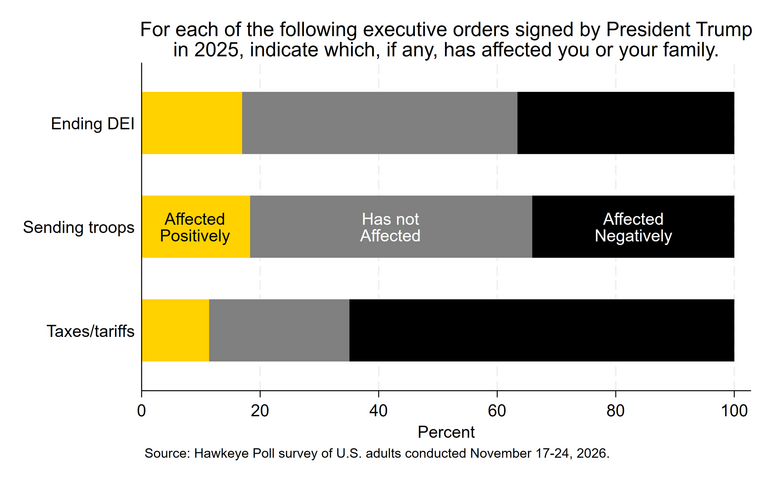
These results varied according to respondents’ self-reported political identification. Democrats most frequently stated they were affected negatively, with 56.2% of Democrats choosing this option. Republicans had vastly different results with only 19.3% of Republicans choosing that they were negatively affected by executive orders.
The November 2025 Hawkeye Poll was conducted by the Department of Political Science. Students in the Hawkeye Poll course wrote and analyzed the questions on executive orders. The Iowa Center for Social Science Innovation (CSSI) assisted with survey programming and data collection. The CSSI contracted with Verasight to field the survey to a demographically representative sample of about 1000 respondents via web panel. For more details, please see the associated press release and topline file.
Dillon Anderson, Abigail Hargrave, William Maramba, and Olivia Boeglin assisted with the preparation of this story and the associated press release.