Data from a recent University of Iowa Hawkeye Poll reveals how Americans use artificial intelligence in their everyday lives. Results indicate that AI is frequently integrated into our daily tasks, with the most reported usage being in summarizing or simplifying information. Conducted November 14-20, 2025, the online survey included 1,002 U.S. voting-age respondents.
Respondents were asked which tasks they had used artificial intelligence for in the past year, including summarizing information, rewriting documents, assisting with schoolwork, supporting critical thinking, drafting materials for work, analyzing data, providing mental health support, using AI in other ways, or not using AI. The most commonly reported use was summarizing or simplifying information, selected by 38.0% of respondents. Other frequently reported uses included using AI in other ways at 34.7%, rewriting or polishing emails or documents at 33.3%, and supporting critical thinking or brainstorming ideas at 29.2%. Smaller shares of respondents reported using AI to assist with schoolwork at 20.5%, draft materials for work at 19.7%, or to analyze data at 20.5%. Using AI for therapy or mental health support was the least frequently reported use at 11.5%. 21.9% of respondents said they had not used AI.
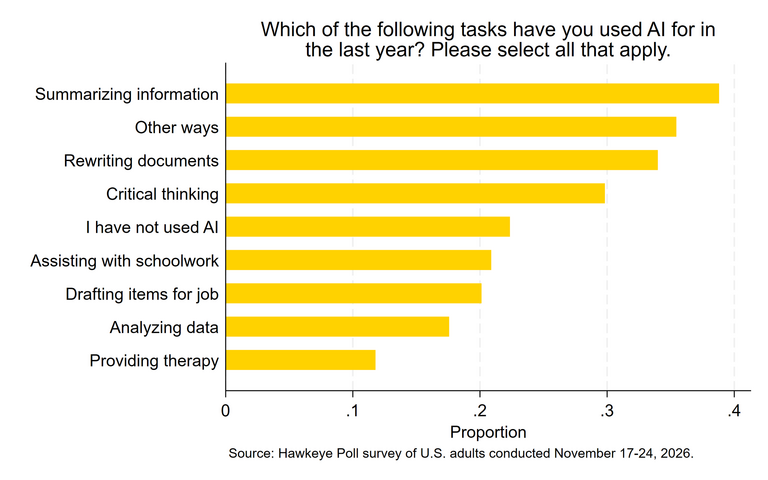
Responses further revealed that the use of artificial intelligence varied by education level. Respondents with a college degree were usually more likely than those without a four-year degree to report using AI to summarize information. Exceptions included using it for schoolwork or in other ways. Those without a college degree were less likely to report using AI at all.
The November 2025 Hawkeye Poll was conducted by the Department of Political Science. Students in the Hawkeye Poll course wrote and analyzed the questions on executive orders. The Iowa Center for Social Science Innovation (CSSI) assisted with survey programming and data collection. The CSSI contracted with Verasight to field the survey to a demographically representative sample of about 1000 respondents via web panel. For more details, please see the associated press release and topline file.
Trevor Janes, Hannah Harclerode, Ava Dravland, and Bella Dougherty assisted with the preparation of this release.